Save Our Hatcheries! |
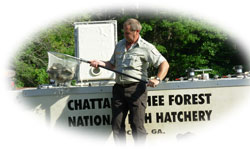
Background "Established in 1871 by Congress through the creation of a U.S. Commissioner of Fish and Fisheries, the National Fish Hatchery System's (NFHS) original purpose was to provide additional domestic food fish to replace declining native fish. Cultured fish were used to replace fish that were lost from natural (drought, flood, habitat destruction) or human (over-harvest, pollution, habitat loss due to development and dam construction) influences, to establish fish populations to meet specific management needs, and to provide for the creation of new and expanded recreational fisheries opportunities." (NFHS Web Site) Since those times our country has undergone vast projects for controlling floodwaters and generating hydroelectric energy with dams. Agencies like the Tennessee Valley Authority and the Army Corps of Engineers (COE) have constructed dams that have disrupted fish populations across the entire country. These dams have made it almost impossible for natural fish populations to survive on their own. As a result, a primary roll of the NFHS has become mitigation of the effects of those projects. The U.S. Fish and Wildlife Service (FWS) administers the NFHS and has been trying to determine who is responsible for funding mitigation activities since Congress never made it completely clear. Currently the FWS believes the COE and other agencies like the TVA are responsible for funding mitigation activities since they are responsible for the projects that require mitigation. Instead of waiting for reimbursable agreements to be fully in place, the FWS proposes to reduce the NFHS's 2012 budget by $6.28 million, the estimated cost to provide mitigation This budget reduction, without a full reimbursement guarantee from agencies like the COE or TVA, may ultimately require the "Shuttering" of at least 9 National Fisheries. Six of those nine are located in the Southeast. They include Chattahoochee Forest National Fish Hatchery in GA as well as hatcheries in TN, AR and KY. The Hatchery Our TU Chapter has worked extensively with the Chattahoochee Forest Hatchery since the Chapter was formed. Therefore, this description will deal primarily with that hatchery. However, the National Fish Hatchery System is a network of facilities that support each other. When one hatchery has a problem, the other hatcheries make adjustments to overcome the problem. The possibility of 9 hatcheries closing is mind-boggling. In a recent economic study (Caudill and Charbonneau, 2010) many of the benefits of maintaining the hatchery were measured. Each year the Chattahoochee Forest Hatchery provides 324,000 stockable size fish into Georgia lakes and streams. Another 460,000 smaller fish are supplied to Georgia Department of Natural Resources hatcheries. "Recreational angling for fish produced by the hatchery results in considerable expenditures of recreation-related goods and services such as lodging, transportation, boats, fishing equipment and other gear used by the fishing public." Since the entire country is suffering from the current, "Great Depression" the economic effect of closing the hatchery would overtly affect the rural areas is serves. Fish production at the Hatchery provides employment for more than 317 people with over $8.2 million in wage and salary income. Retail sales associated with angler expenditures as a result of stocking by the hatchery amounts to over $15 million/year. More than $4 million of that was for food, lodging and transportation. The total economic output of the hatchery was $28.8 Million. Every dollar spent on the hatchery returned $37.20 to our communities. Keeping the Hatchery operating is just good business. In addition to good business, another benefit of stocking by the hatchery has been brought to my attention. When fishing the local rivers and streams, we often witness local families fishing. Not only is it an activity that keeps families together, as a direct result of stocking these "Put and Take" fisheries, many families are able to put dinner on the table! Contact the Director and Asst. Director of the U.S. Fish & Wildlife Service and let them know how important it is to adequately fund the hatcheries. (Click Here) January 2014 - The Struggle Continues Thanks to everyone's hard work our voices were heard, Congress passed and the President signed the Fiscal Year 2012 Appropriation Bill, fully funding the Mitigation Hatcheries. The struggle for funding for the Hatcheries continues, however. Those in charge continue to propose closing Mitigation Hatcheries and cutting the funding necessary to mitigate the effects of Federal water development projects. Rick Nehrling was a National Fish Hatchery Service (NFHS) employee for 38 years and retired in 2008. His knowledge and insight offer those of us unfamiliar with the working of government agencies an opportunity to see what is really going on at the National Fish Hatcheries. Listed below are Rick's Letters to "The Directorate" of the NFHS. These letters include links to documents relevant to our goal of keeping the hatcheries open and adequately funded. If you have comments or contributions please email them to tu692@ngatu692.com ***************************************** April 2014 - Time To Make Ourselves Heard! It is, once again, time to write our Congressmen and Congresswomen! Please - CLICK HERE for a new page with ready-made letters. Just click and print. It will only take a couple of minutes! ***************************************** Open letters and articles concerning the fight to keep our Hatcheries Operating: 04/15/15 To clarify my position - Deb Burger 03/24/15 National Fisheries Friends Partnership Update 03/24/15 Norfork NFH Funding Update 03/25/15 Note from Rick Nehrling ~~~~~~~~~~~~~~~~~~~~~~~~~~~~~~~~~~~~~~~~~~~~~~~~~~~~~~~ 08/18/14 Draft Appropriations Bill 07/10/14 Interesting bills, proposals - DC Booth 05/19/14 Moving On 05/19/14 Problems with the TVA Reimbursement 04/08/14 Fisheries Zero-Sum Gain is Directly Connected to the Incompetence of the Directorate! 04/02/14 If Congress Can Define Full Reimbursement - Why Can't the Directorate Define It! 04/01/14 The Corps of Engineers Wants to Work with the Directorate on Determining the Correct Amount of Reimbursable Funding Needed for the COE Mitigation Hatcheries 03/26/14 The Directorate's Crack Negotiation Team Has Again Negotiated the COE Mitigation Hatcheries Into Closure Status? 03/25/14 The Directorate's Not Officially Closing Hatcheries but it Continues to Mislead! 03/19/14 The Directorate's Incompetence and Illegal Transferring of Appropriated Funds Has Cost the Mitigation Hatcheries $19.438 Million 03/18/14 The FY 2015 COE Reimbursable of $4.7 Million Means That the Directorate has Set Up the Mitigation Hatcheries for Closure - For the Fourth Year In A Row!! 03/12/14 It Appears that the Directorate is Poised to Close the Mitigation Hatcheries in FY 2015 03/11/14 Congressional Oversight Hearing on the REPORT! 03/05/14 The REPORT - Incomplete FY 2012 Congressional Add On Funding Data Makes the REPORT Worthless! 03/03/13 The REPORT - Incomplete FY 2012 COE Reimbursable Funding Data Makes the REPORT Worthless! 02/26/14 The REPORT - It Appears That the Directorate Has Caused the Present Fisheries Funding Base Deficit! 02/25/14 The REPORT - It Appears That the Service's New Policy Regarding Mitigation Hatchery Funding Is Not a Written Policy But a Verbal Policy 02/19/14 The REPORT - The Directorate's Testimony Before Congress Contradicts the Directorate's Proposal to Close the COE Mitigation Hatcheries! 02/18/14 The REPORT - It Appears that the Directorate Set Up the COE Mitigation Hatcheries for Closure in FY 2012 02/12/14 The REPORT - The Directorate Royally "Screwed the Pooch" with the FY 2011 Corps of Engineers Reimbursable Negotiations! 02/11/14 The Report - The Directorate "Screwed the Pooch" with the FY 2010 Corps of Engineers Reimbursable Negotiations! 02/05/14 The Report - The Minimum Amount of Reimbursable Funding Needed from the COE is $6 million! 02/04/14 The REPORT - What Must the Corps of Engineer Reimbursable Cover? 01/29/14 The REPORT - Understanding the Service's FY 2012 Fisheries Budget Appropriated by Congress, the Congressional Add On and the Budget Language 01/28/14 The REPORT - Understanding the Service's FY 2012 Mitigation Hatchery Budget Request 01/22/14 The REPORT - The FY 2012 Data is Outdated and Incomplete! 01/21/14 The REPORT - The Proposed Closure of the DC Booth Historic Fish Hatchery Makes No Sense Whatsoever! 01/15/14 The MEMO Appears to Say "We Are Closing the Mitigation Hatcheries No Matter What Happens"! 01/14/14 The MEMO - It Appears that the Ongoing Three Year Push to Close the Mitigation Hatcheries is Driven by the Directorate's Personal Agenda |
















Home |
Home |

